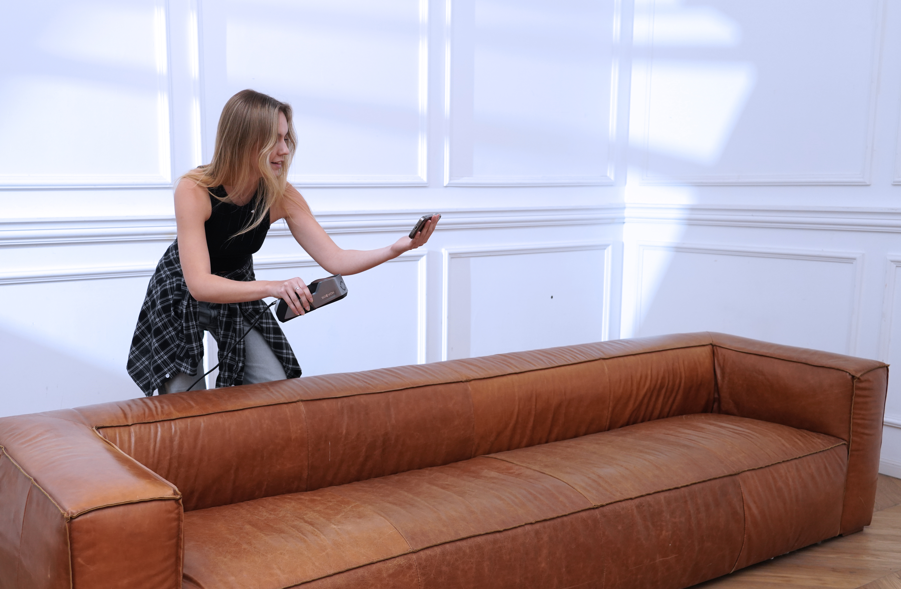
In the furniture industry, precision, efficiency, and design flexibility are essential for creating products that meet both aesthetic and functional requirements. Professional 3D scanners have become valuable tools that assist designers, craftsmen, and manufacturers in capturing accurate shape data and streamlining various production processes. This article explores how these devices can be effectively applied in furniture design and manufacturing, helping teams improve efficiency and enhance product quality.
Understanding Professional 3D Scanners
Professional 3D scanners are capable of capturing the geometry and surface details of physical objects and generating accurate digital 3D models. Using technologies such as blue laser lines and infrared laser lines, these scanners can efficiently digitize furniture components, handcrafted models, or decorative structures.
In the furniture industry, where organic shapes, curves, and textures are common, a precision 3D scanner allows designers and engineers to record complex surfaces that are difficult to measure manually. These digital replicas serve as valuable references during product development, redesign, or customization.
Benefits of Using Professional 3D Scanners in Furniture Manufacturing
One of the key advantages of using 3D scanners in the furniture sector is the speed and accuracy of data collection. Traditional measurement methods may be time-consuming and prone to inconsistencies, especially for irregular wooden components, carved decorations, or ergonomic furniture parts.
A precision 3D scanner can quickly capture accurate dimensions, streamlining tasks such as:
- Digitizing prototypes
- Recreating existing furniture pieces
- Documenting handmade craftsmanship
- Preparing data for CNC machining or 3D modeling
The captured 3D data can be easily analyzed and modified using design software, enabling furniture designers to refine shapes, improve ergonomics, and experiment with new styles more efficiently. This results in shorter development cycles and more consistent output quality.
Enhancing Quality Control and Custom Furniture Design
Quality control is crucial in furniture manufacturing, especially when ensuring that components fit together properly and meet design specifications. Professional 3D scanners help manufacturers:
- Verify dimensions of wooden components
- Check assembly accuracy
- Detect shape deviations caused by processing
- Maintain consistency in mass production
For custom furniture makers, 3D scanning is particularly useful. Designers can scan existing spaces, interior environments, or client-provided reference pieces to ensure that new furniture matches the required proportions and style. This significantly improves communication with customers and helps produce designs that meet personalized needs.
By incorporating 3D scanning technology into quality assurance and design workflows, furniture manufacturers can reduce errors, avoid rework, and deliver more reliable results.
The Future of Furniture Design with 3D Scanning Technology
As scanning technology continues to advance, its role in the furniture industry is becoming increasingly diverse. Multi-light-source systems—such as those used in devices like the 3DeVOK MT—are making 3D scanning more accessible for designers, artisans, and small workshops.
These innovations support a wide range of applications, including:
- Restoring antique furniture
- Digitizing handcrafted carvings
- Creating catalogs of digital assets
Supporting hybrid manufacturing workflows combining CNC, 3D printing, and traditional craftsmanship
In summary, the application of professional 3D scanners in furniture design and manufacturing offers significant benefits in terms of speed, precision, and workflow optimization. By adopting these technologies, furniture creators can enhance design capability, improve production efficiency, and deliver products with higher aesthetic and functional value.
3DeVOK is committed to providing versatile and practical 3D scanning solutions that empower furniture designers, craftsmen, and manufacturers to bring their creative visions to life.
