A spot welding machine can have capable mechanical hardware, yet welding consistency still depends heavily on how accurately its electrical process is controlled. Current, weld time, feedback, pressure-related signals, schedules, and communication all influence how the machine responds to changing production conditions.
For manufacturers in automotive, battery, electronics, and general metal fabrication, the controller is therefore a process-control component rather than merely an accessory to the welding transformer.
What the Controller Actually Controls at the Weld Point
At its most basic level, a resistance welding controller manages the electrical conditions used to create the weld. Heat is generated at the contact resistance between the workpieces, so controlling welding current and time is fundamental to controlling heat input.
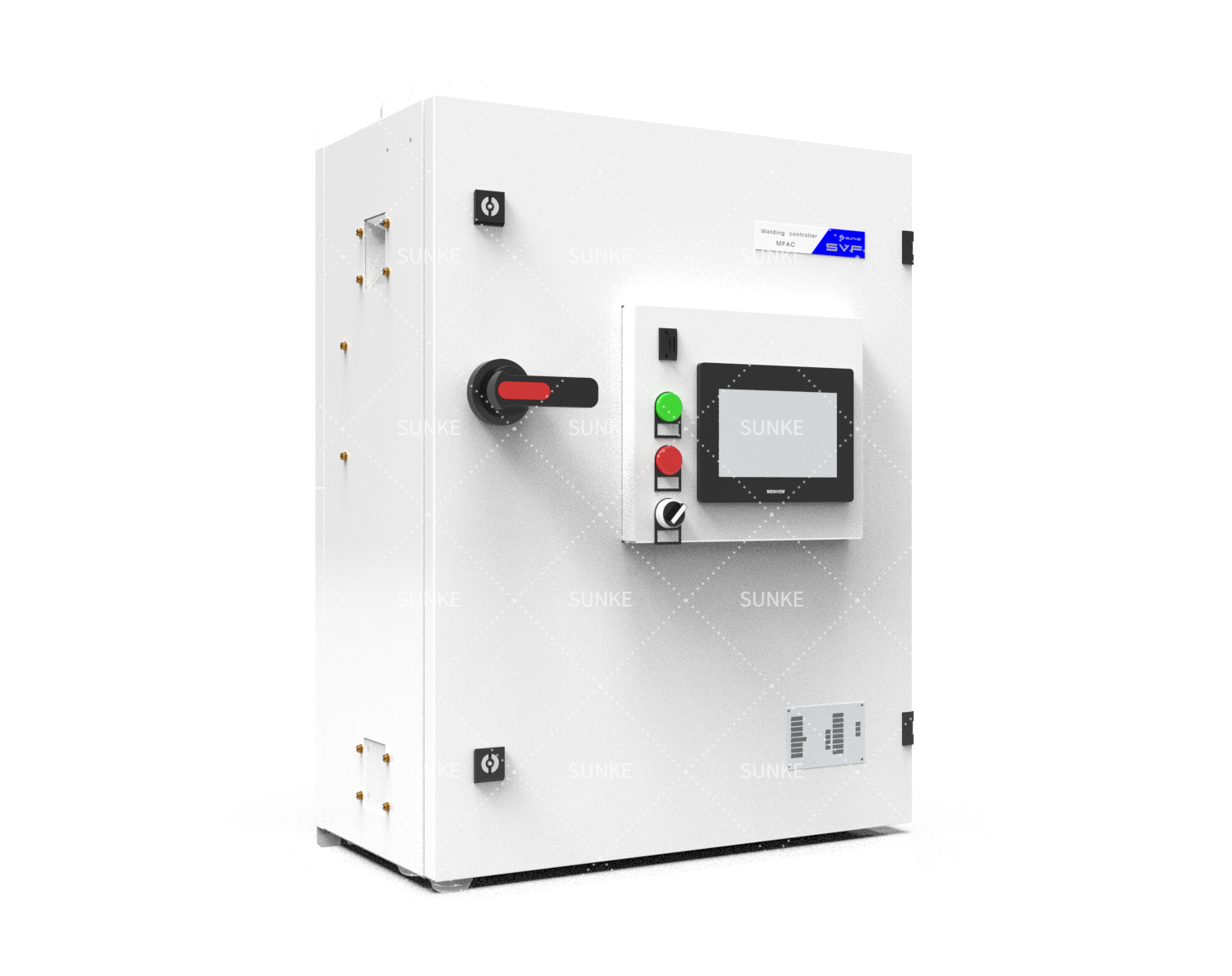
A modern resistance welding controller can also coordinate different operating functions around that electrical output. Sunke’s published controller range supports spot, projection, and seam welding applications, with configurations intended for manual, fixture-based, and automated systems.
That distinction matters in production because the welding controller sits between the process specification and the physical welding equipment. The machine supplies electrode force and mechanical positioning; the controller determines how the programmed electrical welding cycle is delivered.
Current Precision Is Only the Starting Point
Current accuracy becomes particularly important when manufacturers need repeatable welds across large production volumes. Excessive variation in current or weld duration can change heat input and consequently affect the resulting joint.
Their MFDC controller documentation specifies primary and secondary current control, secondary feedback, programmable welding schedules, and control methods including KSR, KUR, PHA, and SAIRS. The published MFDC range also includes different output-current configurations and air- or water-cooling options.
Such capabilities give engineers more control over the welding cycle than a basic fixed-output system. The benefit is not simply a higher specification on the controller datasheet. Better control can make process parameters more repeatable when production requires narrow operating windows.
Timing resolution is another part of this equation. Weld time, current rise behavior, pulse structure, and sequence timing can all affect the thermal cycle. For applications requiring different welding conditions, the ability to configure these variables becomes part of process development rather than an afterthought.
One Controller, Multiple Welding Recipes
Production rarely involves a single joint configuration forever. A manufacturing line may process different materials, thickness combinations, components, or product variants. Reconfiguring electrical parameters manually for every change increases the possibility of setup errors.
Programmable weld schedules address this problem by storing process recipes that can be selected as required. They state that their MFDC and MFAC controllers support 256 weld schedules, while the controllers can be externally accessed and activated according to production requirements.
This feature becomes useful when a line needs controlled transitions between products rather than a single permanent welding setting. Engineers can define different current, timing, and control parameters for validated applications, while the automation system can select the appropriate program during production.
For high-mix manufacturing, the practical benefit is therefore configuration control. The controller becomes a mechanism for preserving validated welding parameters instead of relying on operators to reproduce settings manually.
Feedback Turns Welding From Open-Loop to Process-Controlled
Programming the correct welding current is not always enough because the electrical resistance of the joint can change during welding. Material condition, surface condition, electrode condition, and other process variables can influence the welding response.
Secondary feedback provides additional information from the welding circuit. Their MFDC documentation specifies secondary feedback, while its description of SAIRS adaptive control states that dynamic resistance changes can be collected from secondary voltage and current and used to adjust welding current and time in real time.
That creates a more responsive control architecture. Instead of treating every weld as electrically identical, the controller can use measured process behavior to respond to variation.
Real-time monitoring also has a diagnostic function. Sunke describes touch-screen operation and monitoring features intended to provide visibility into the welding process and support troubleshooting and optimization. For production engineers, this visibility can shorten the path between a welding abnormality and its investigation.
The Controller Has to Speak the Language of the Factory
Modern welding equipment rarely operates as an isolated machine. Automated lines need controllers to exchange signals with robots, PLCs, production-management systems, sensors, and other equipment.
Communication therefore becomes a practical feature rather than a convenience. Their published MFDC and MFAC controllers list Ethernet and industrial fieldbus options including PROFINET, PROFIBUS, DeviceNet, EIP, and CC-Link.
For an integrator, this can simplify the connection between welding control and the wider automation architecture. Production commands can be coordinated with weld schedules, while machine status and process information can be incorporated into the control system.
A resistance welding controller selected without considering the factory’s communication architecture may create integration work later, even if its welding performance is technically adequate.
Selecting a Controller by Process Requirements
Controller selection should begin with the welding application rather than with output current alone. Their own selection guidance asks users to provide material type and thickness, input voltage, welding current and time, welding beat, communication requirements, adaptive functions, secondary output requirements, and cooling preferences.
Those questions reflect the information an engineering team needs to match controller capability with the actual production process. Automotive body components may prioritize automated communication and repeatable schedules, while electronics applications may require more precise process control. Battery-related production can introduce additional requirements around material combinations, heat input, and monitoring.
Their controller portfolio includes MFDC, MFAC, and capacitive-discharge technologies, allowing the control architecture to be considered alongside the welding application rather than treating every resistance welding process identically.
The most useful benefit of a spot welding controller is ultimately its ability to turn welding parameters into a controlled, repeatable production process. A capable controller combines current and timing control with programmable schedules, feedback, diagnostics, and factory communication.
These features should be evaluated by manufacturers in relation to the material, joint geometry, production takt, quality requirements, automation architecture, and real application when assessing a resistance welding controller. That choosing machinery based on a static rating or feature list is meaningless compared to process-based evaluation.
