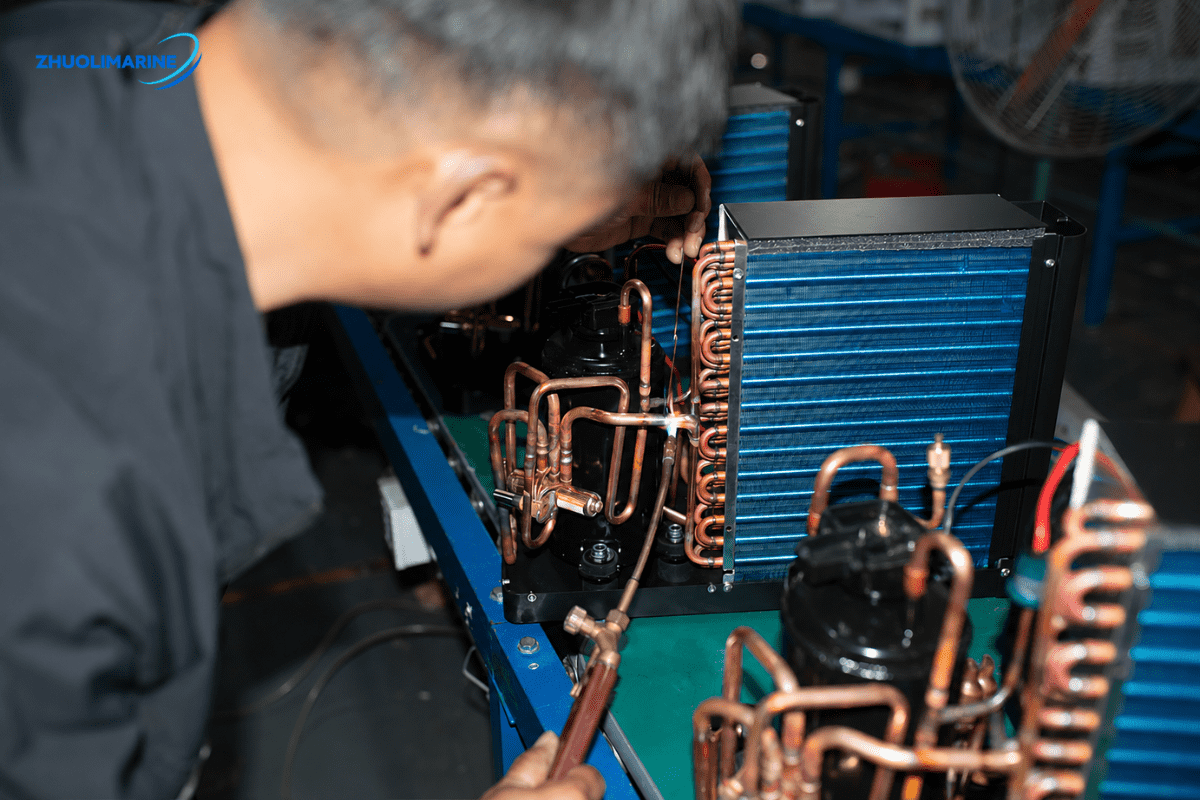
After winter storage, a working thermostat display cannot establish the condition of the seawater circuit, fan passages or electrical connections. Cooling equipment may appear ready while an intake restriction or blocked return grille remains unnoticed.
A sensible pre-season boat air conditioner service routine therefore checks the systems supporting refrigeration before judging cabin temperature. The purpose is to establish a safe operating baseline and catch faults while the vessel is still accessible for maintenance.
Begin with Access and Visible Condition
Inspection starts with the unit safely isolated according to the vessel’s electrical and equipment procedures. Loose fasteners, moisture marks, cracked hoses and strained wiring are visible warning signs even before a compressor runs.
Where a cabinet sits beneath a berth, temporary stored gear may obstruct service panels or air inlets. Clearing access also creates room to detect leakage when the installation is tested later.
Marine exposure affects the supporting parts as well as the cooling machine. Stainless-steel housings and protective coatings are intended to resist the environment, but their condition still warrants examination.
The same applies to hose clamps, brackets and electrical terminals in damp compartments. A conspicuous defect should be addressed before operating the equipment; a checklist is not permission to energize a damaged circuit.
Follow the Seawater Circuit in Order
The condenser cannot reject cabin heat effectively without an adequate cooling-water path. Starting at the intake, an inspection can trace the strainer, valves, pump, hoses, heat-exchanger connections and overboard discharge.
A dirty strainer or partly closed valve may restrict circulation. An air pocket or unfavorable pump arrangement can cause cavitation, which may be accompanied by a change in sound, vibration and reduced water movement.
A pre-season boat air conditioner service check distinguishes a pump receiving electricity from a circuit actually carrying water. Intake and priming procedures depend on the installed pump and vessel layout, and the system must not be run contrary to its operating instructions.
Once safe operation has been established, observable discharge and unusual noise can be compared with previous records. Weak circulation merits investigation before long cooling tests proceed.
Restore the Air Route and Check the Controls
A clean seawater path will not compensate for a blocked air return. Dusty filters, crushed flexible ducting, closed grilles and luggage stacked over an intake can limit the air reaching the evaporator. Supply outlets need to distribute conditioned air into the occupied cabin, while the return opening needs room to draw it back. Both sides of the path deserve a visual check before the thermostat is used to request cooling.
The original installation matters here: duct and grille arrangements are selected for the boat rather than built into every air-conditioning package. A filter found in one position on a Yacht may sit elsewhere on another vessel. Photographs taken before removing covers can preserve the intended routing and make correct reassembly easier.
The MAR-12V/12BP Yacht unit in ZhuoliMarine‘s range has a replaceable filter and an adjustable blower capable of 360-degree positioning. Those features illustrate why the installed outlet position and filter access matter during maintenance.
Controller checks can then cover temperature response, operating mode and any available Wi-Fi functions, without assuming that a responsive display proves the full refrigeration circuit is healthy.
Compare Observations with the Actual Model
A reading is useful only when it belongs to the equipment being tested. The 12V MAR-12V/09BP specifies 9,000 BTU cooling, 660 W rated input, 500 m³/h airflow and 720 L/h seawater flow. A distinct 12V Yacht unit rated at 12,000 BTU specifies 840 W, 550 m³/h airflow and 1,080 L/h water flow. These are model specifications, not interchangeable maintenance thresholds.
The 220V MAR-220/16BP is different again, with 16,000 BTU cooling, 1,130 W rated input, 650 m³/h airflow and 1,250 L/h water flow. ZhuoliMarine provides installation documentation and remote technical assistance that can help identify the correct parameters before measurements are interpreted.
Actual field readings depend on installation conditions and the test method; an apparent mismatch deserves investigation rather than automatic adjustment to a number copied from another machine.
Test Recovery and Leave a Clear Handover
The final functional check needs enough time for the cabin and discharge behavior to respond under the conditions available at the berth. Irregular pump sound, recurrent alarms, weak supply airflow and water leaks are reasons to stop and investigate.
A short dockside run cannot reproduce every hot-weather load, so unresolved symptoms should be recorded along with the temperature setting and conditions observed during the test.
Boat air conditioner service is complete for the season only to the extent that defects have been evaluated and safe operation confirmed. A note identifying the cleaned component, replaced hose or outstanding concern is more useful than a generic tick beside “working.” If further electrical or refrigerant work is required, the handover should identify a qualified technician and the evidence already collected, preventing unnecessary repeat checks.
A pre-season handover needs a record of the conditions tested and a separate list of outstanding faults. Model-specific documentation and remote assistance for ZhuoliMarine equipment can clarify procedures, while replacement-part access is relevant when components require renewal.
Electrical or refrigerant repairs still require suitably qualified personnel at the vessel. The maintenance record should include test observations and the schedule for any unresolved onboard checks.
