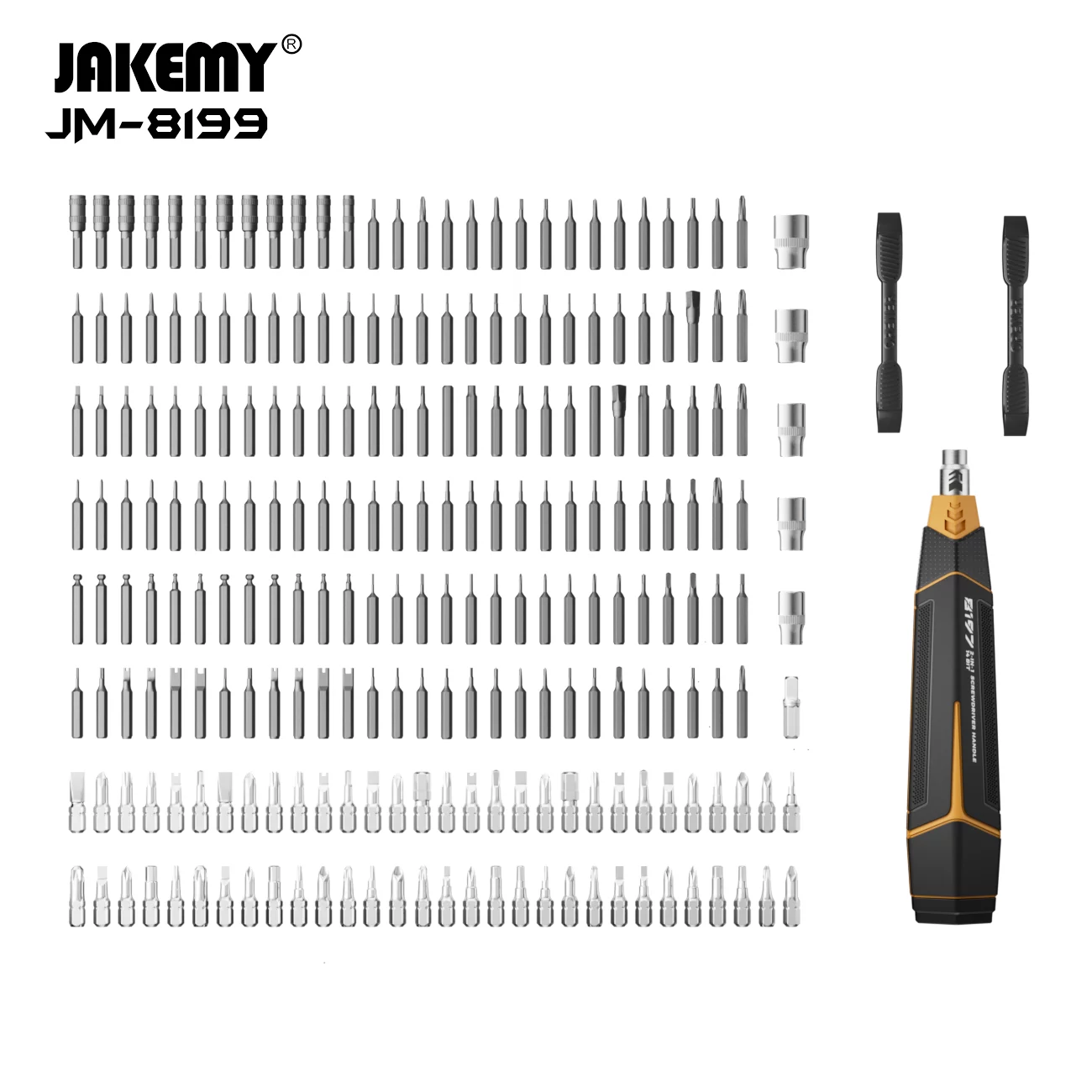
Modern electronics repair benches face friction from device miniaturization, proprietary fasteners, and tight spatial enclosures. Technicians frequently lose billable diagnostic hours searching through mismatched toolboxes to extract deeply seated screws from smartphones, laptops, and drones. Stripped screw threads compound these delays, turning simple battery or screen replacements into costly liabilities.
Investing in the Jakemy JM-8199 provides technical departments with a centralized, high-density solution engineered to eliminate common maintenance bottlenecks. Designed as a comprehensive 257-in-1 manual toolkit, this system directly resolves recurring problems regarding tool wear, shank sizing mismatches, and disorganized bench space.
Fastener Proliferation and Incompatible Drive Geometries
Hardware manufacturers frequently deploy specialized fastener drives across consumer devices, appliances, and computing gear to discourage unauthorized tampering. Technicians confronted with security torx, pentalobe, tri-wing, and micro-hex screws often discover missing bit sizes that halt urgent maintenance midway. Searching through separate boxes wastes valuable labor hours and interrupts diagnostic workflows.
Designed for versatility, this bit set accommodates a variety of screwdriving and disassembly tasks. Its selection of bits supports work on a wide range of products, from delicate eyeglasses and small electronic devices to household appliances and automotive interior components.
Extensive bit assortments also eliminate the hazard of forcing close-enough driver heads into delicate recesses. Matching exact fastener dimensions prevents cam-out slippage and preserves fragile screw heads on expensive mobile motherboards or sensitive drone flight controllers.
Clearance Restrictions Versus High-Torque Resistance
Technicians routinely confront a frustrating mechanical trade-off between driving torque and physical clearance. Slim precision driver bodies fit comfortably inside narrow drone chassis or phone frames but cannot supply sufficient turning leverage to loosen stubborn, factory-torqued chassis fasteners.
Conversely, heavy-handled screwdrivers generate impressive rotational force but remain far too cumbersome to navigate recessed battery compartments or fragile ribbon cable pathways. Forcing oversized handles into cramped device interiors risks cracking brittle plastic housings, scratching glass panels, or crushing adjacent micro-components.
Overcoming this dilemma requires mechanical versatility delivered through an innovative nested dual-handle structure. A compact inner driver nests smoothly inside an ergonomic outer handle, allowing operators to use the slender core independently for tight-access electronics or assemble the full unit to maximize manual torque without stripping screw heads.
Shank Incompatibility and Adapter Wobble
Standard precision toolkits depend on loose intermediate sleeves to adapt smaller 4mm bits to standard quarter-inch drive handles. Extra adapters introduce noticeable rotational play, which wobbles under pressure, compromises fastener engagement, and damages shallow drive sockets on sensitive circuit boards.
Utilizing the Jakemy JM-8199 eliminates loose intermediate connectors through a patented two-in-one chuck mechanism that accommodates both H4.0 and H6.3 shanks natively. Direct shank engagement ensures concentric alignment, delivering smooth rotational transfer and preventing microscopic cam-out accidents during delicate laptop motherboard repairs.
Eliminating auxiliary collets also streamlines servicing speed across mixed assemblies. Operators swap between high-torque casing bits and micro-screws without fumbling through magnetic sleeves, keeping assembly sequences fluid and precise.
Component Loss and Bit Degradation from Heavy Wear
Microscopic electronics fasteners easily tumble into intricate chassis cavities during routine battery replacements or camera module swaps. Dislodged steel screws can lodge behind power rails, short-circuit internal traces, and permanently ruin expensive printed circuit board assemblies during post-service power cycles.
Retrieving dropped hardware from deep sub-chassis voids without dedicated tools frustrates technicians and inflates bench repair times. Traditional non-magnetic bits offer zero fastener retention, forcing operators to balance tiny screws manually on fingertips across delicate circuitry.
Precision-machined magnetic tips grip delicate fasteners securely, enabling controlled extraction and effortless alignment inside deep housing recesses. Furthermore, durable chrome-vanadium alloy steel treated with protective black phosphate resists tip shearing, structural deformation, and surface oxidation throughout thousands of rigorous service cycles.
Inflexible Layouts and Mobile Service Disorganization
Static toolboxes often force mobile technicians to carry unnecessary bulk or endure disorganized trays where bits shift during transit. Scrambling to locate correct bits slows repair queues, frustrates field personnel, and projects an unprofessional image to retail customers waiting for turnarounds.
Jumbled trays also lead to lost accessories, leaving technicians missing critical bits when high-priority repair orders arrive. Unsecured tools rattling inside cases cause premature dulling of finely machined bit flutes before they touch a screw.
Modular internal storage allows workshop managers to rearrange modules or segment bit selections according to specific repair stations. Secure molded compartments protect individual components from shifting, while customizable side labeling ensures swift identification during fast-paced assembly and field maintenance operations.
Procurement Bottlenecks for Custom-Branded Workstations
Growing repair franchises often struggle to procure enterprise-grade tools that accommodate corporate branding without demanding prohibitive minimum order volumes. Traditional tool suppliers impose steep volume requirements or rigid casing graphics that prevent regional service networks from establishing unified brand recognition.
Sourcing fragmented tool inventories across multiple third-party vendors also creates inconsistent repair quality and unpredictable warranty claims. Procurement departments face administrative headaches reconciling mismatched supplier invoices, erratic production lead times, and irregular hardware quality standards.
Direct factory customization removes these commercial barriers through low 100-piece baseline order quantities and customizable nameplates. Operations teams can select bespoke modular configurations and custom-printed adhesive labels, pairing rapid 7-to-14-day prototype sampling with dependable 20-day production schedules for growing service chains.
Systematic Resolution of Everyday Maintenance Friction
Electronics rework demands tools engineered to resolve friction across every stage of diagnosis, mechanical disassembly, and reassembly. Eliminating missing bit profiles, unstable adapters, unmagnetic drives, and rigid carrying cases directly elevates bench productivity while safeguarding delicate consumer hardware.
Deploying the Jakemy JM-8199 transforms technical chaos into a streamlined workflow by consolidating 257 specialized accessories into an adaptable, high-density platform. Technicians gain the exact leverage, fit, and organization required to execute flawless repairs across modern electronic ecosystems.
