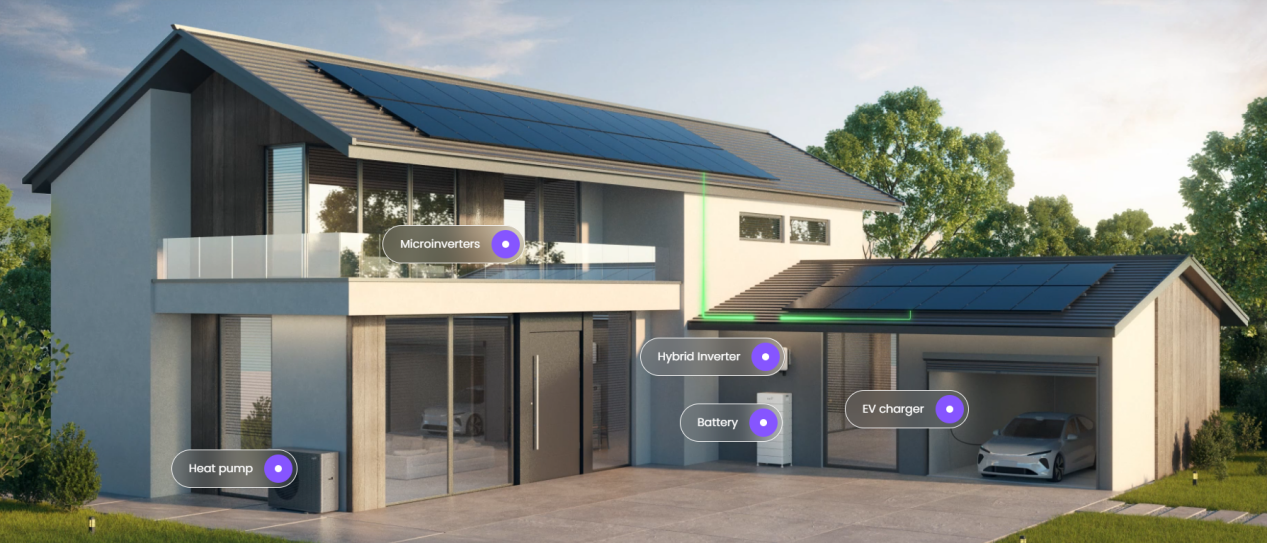
A residential energy system can begin with rooftop solar, but today’s households may eventually need much more: battery storage, EV charging, electric heating, and digital energy management.
Understanding the Fox ESS product ecosystem therefore requires looking at how its product categories connect rather than treating each device as an isolated purchase. The portfolio is structured around a broader energy journey, from generating electricity to storing, using, and managing it.
From PV Generation to a Connected Energy Portfolio
Solar generation provides the starting point for many residential energy systems. The Fox ESS portfolio includes PV inverters and microinverters designed to convert electricity generated by photovoltaic modules into usable power for the household or wider electrical system. Its product range also includes hybrid inverters, creating a pathway from solar generation toward integrated storage.
That distinction is useful when understanding the wider portfolio. A PV inverter primarily addresses the conversion requirements of a solar installation, while a hybrid inverter is designed around a system in which battery storage also forms part of the architecture.
The result is not simply a larger collection of inverter models. Different inverter types provide different starting points for residential system design, allowing installers to build configurations around the customer’s existing equipment, planned storage, and broader energy requirements.
This generation layer gives the rest of the ecosystem something to work with. Once solar electricity can be converted and used within the property, the next question becomes how that energy can be retained and made available when generation and consumption do not coincide.
Hybrid Inverters and Batteries Form the Storage Core
Battery storage is where the portfolio becomes more closely integrated. Solar generation typically varies throughout the day, while household demand follows its own pattern. A battery provides a way to shift available electricity across time, while the hybrid inverter provides the electrical interface between generation, storage, household loads, and the grid within the supported system architecture.
The Fox ESS hybrid inverter range includes single-phase, split-phase, and three-phase products. Its portfolio places these inverters alongside high-voltage battery products, allowing the storage system to be designed as a coordinated combination rather than as unrelated components.
The KH/KA provides a specific example of this relationship. The product is a single-phase hybrid inverter with a 7–10.5 kW power range and high-voltage battery compatibility. Its product information also highlights flexible configuration, plug-and-play installation, built-in fuse protection, and remote monitoring.
Battery modularity adds another dimension. The company’s battery portfolio includes high-voltage storage products with expandable configurations, allowing different storage capacities to be considered within supported system designs.
The S22 demonstrates a more integrated approach. Rather than separating the storage components into conventional individual units, the product is presented as an all-in-one storage system with flexible configuration, plug-and-play setup, built-in fuse protection, and IP65 protection.
Together, these products show why the inverter and battery relationship is central to understanding the ecosystem. The storage proposition is not just about adding more battery capacity; it is about creating a coordinated electrical architecture.
EV Charging and Heat Pumps Extend the Home Energy Ecosystem
Once solar and storage are connected, household electricity use becomes the next part of the ecosystem. EV charging is a natural extension because an electric vehicle represents a significant electrical load that can potentially be incorporated into a broader household energy strategy.
The Fox ESS product portfolio includes EV chargers alongside its solar and storage equipment. The category is positioned as part of the company’s wider residential energy offering, extending the system beyond generation and storage into transportation electrification.
Heat pumps broaden that energy relationship further. Instead of treating household heating as a separate technology, an integrated energy ecosystem can include heating among the property’s major electrical loads.
Fox ESS lists heat pumps within its product portfolio, alongside PV, storage, EV charging, and other energy technologies. This wider product coverage supports the company’s move toward a complete household energy platform rather than a portfolio focused exclusively on batteries and inverters.
That distinction is important for understanding the term “ecosystem.” Its meaning comes from the relationship between technologies. Solar can generate electricity, batteries can store it, EV chargers can direct electricity toward vehicle charging, and heat pumps can serve electrified heating requirements. Each category addresses a different part of household energy use.
FoxCloud Brings the Hardware Into One Digital Layer
More connected equipment creates more information to manage. A homeowner may need to understand solar generation, battery status, household consumption, EV charging, and other energy activity without switching between unrelated systems.
FoxCloud provides the digital layer for this environment. Its product information describes monitoring and management functions that give users visibility into energy production and consumption while supporting control of connected energy equipment.
FoxCloud 2.0 also introduces more advanced management capabilities. Official materials highlight dynamic electricity tariff functions and AI-based energy management, bringing pricing information, energy behavior, and system conditions into a more intelligent management framework.
This makes software an important part of the ecosystem rather than an optional add-on. Hardware generates and consumes energy, while the digital platform provides the information and control layer needed to understand those interactions. By unifying monitoring, tariff management, and AI-assisted optimization, FoxCloud exemplifies how intelligent energy solutions can transform hardware connectivity into practical household energy control.
The same direction was highlighted at SNEC 2026 and The Smarter E Europe 2026, where Fox ESS presented its products as part of a dynamic and integrated energy ecosystem spanning storage, EV charging, heating, and digital management.
Why the Ecosystem Matters More Than Individual Products
Looking at the portfolio as separate product categories can obscure its underlying structure. PV equipment addresses generation, hybrid inverters connect generation and storage, batteries provide energy storage, EV chargers and heat pumps extend electricity use, and FoxCloud provides the digital layer that connects the system.
Fox ESS describes this direction through its positioning around smart renewable energy and an integrated energy ecosystem. Its 2026 product demonstrations emphasized how multiple technologies can operate within a broader residential and commercial energy framework.
When it comes to energy planning, the ecosystem method gives homeowners a new perspective that goes beyond just one installation. Electric vehicle charging, electric heating, and other energy-management features can be added to a property that already has photovoltaic (PV) and storage systems.
Installers and distributors can view the same structure from a different perspective. A broader product ecosystem creates more opportunities to configure complete energy systems while working within a connected technology portfolio and digital platform.
Ultimately, the defining feature of the Fox ESS ecosystem is the relationship between its components. Solar generation supplies energy, hybrid inverters manage the electrical architecture, batteries provide storage, EV chargers and heat pumps create additional electrified applications, and FoxCloud brings monitoring and intelligent control into the same broader framework.
That connected structure is what turns a collection of products into an ecosystem—and explains the company’s wider approach to intelligent energy storage solutions.
