A product team building a smart camera assumes the cloud will handle the hard part. Then a customer deploys it in a facility with unreliable network coverage, and suddenly the promised real-time alerts arrive minutes late, if they arrive at all. The gap between a connected product and an intelligent one usually surfaces exactly when it matters most.
By the time the delay is noticed, the damage is already done. A security camera that flags an intrusion five minutes after it happened has not really provided security, it has provided a record. The same is true for a factory sensor that reports an equipment fault only after the line has already stopped, or a vehicle system that recognizes a hazard a beat too late to matter.
What makes this scenario particularly uncomfortable for product teams is that the underlying hardware often worked exactly as designed. The camera captured clear footage, the network delivered the data, and the cloud service ran its analysis correctly. The failure was never in any single component, it was in the architecture that assumed a stable, low-latency connection would always be available.
Field conditions rarely cooperate with that assumption. Warehouses have dead zones behind steel shelving, rural facilities sit on thin bandwidth, and moving vehicles lose signal the moment they enter a tunnel or a parking structure. A product built to depend on constant connectivity is, in practice, a product built to fail intermittently in exactly the environments its customers actually operate in.
This is the moment many teams realize that intelligence cannot live entirely SoMewhere else. If a device is expected to react in real time, it needs the capability to do so on its own, regardless of whether the network happens to be cooperating at that particular moment.
When On-Device Intelligence Becomes a Product Requirement
Sending every frame or sensor reading to a remote server for analysis works fine in a demo. It works far less reliably once a product ships into warehouses, vehicles, or rural facilities where connectivity is inconsistent and every added round trip introduces delay that a real-time application cannot tolerate.
This is why on-device inference has moved from a nice-to-have to a baseline expectation for many connected products. Edge AI Computing shifts the analysis onto the device itself, so decisions happen the instant data is captured rather than after it has traveled to a server and back.
The Hidden Cost of Offloading Inference to the Cloud
Beyond latency, cloud-dependent AI carries costs that rarely show up until a product scales. Bandwidth and server processing fees grow with every deployed unit, turning what looked like a manageable software expense during prototyping into a significant recurring cost once thousands of devices are shipping data continuously.
Privacy expectations compound the problem further. Many customers, particularly in healthcare, retail, and industrial settings, are wary of continuous raw data leaving their premises. Processing sensitive footage or sensor data locally, rather than streaming it externally, has become a selling point in its own right rather than a compliance afterthought.
What a Qualcomm SoM Adds to the Equation
Running inference locally is only practical if the underlying hardware is built for it. A processor without a dedicated neural accelerator forces AI workloads onto general-purpose CPU cores, which quickly become a power and performance bottleneck as model complexity grows.
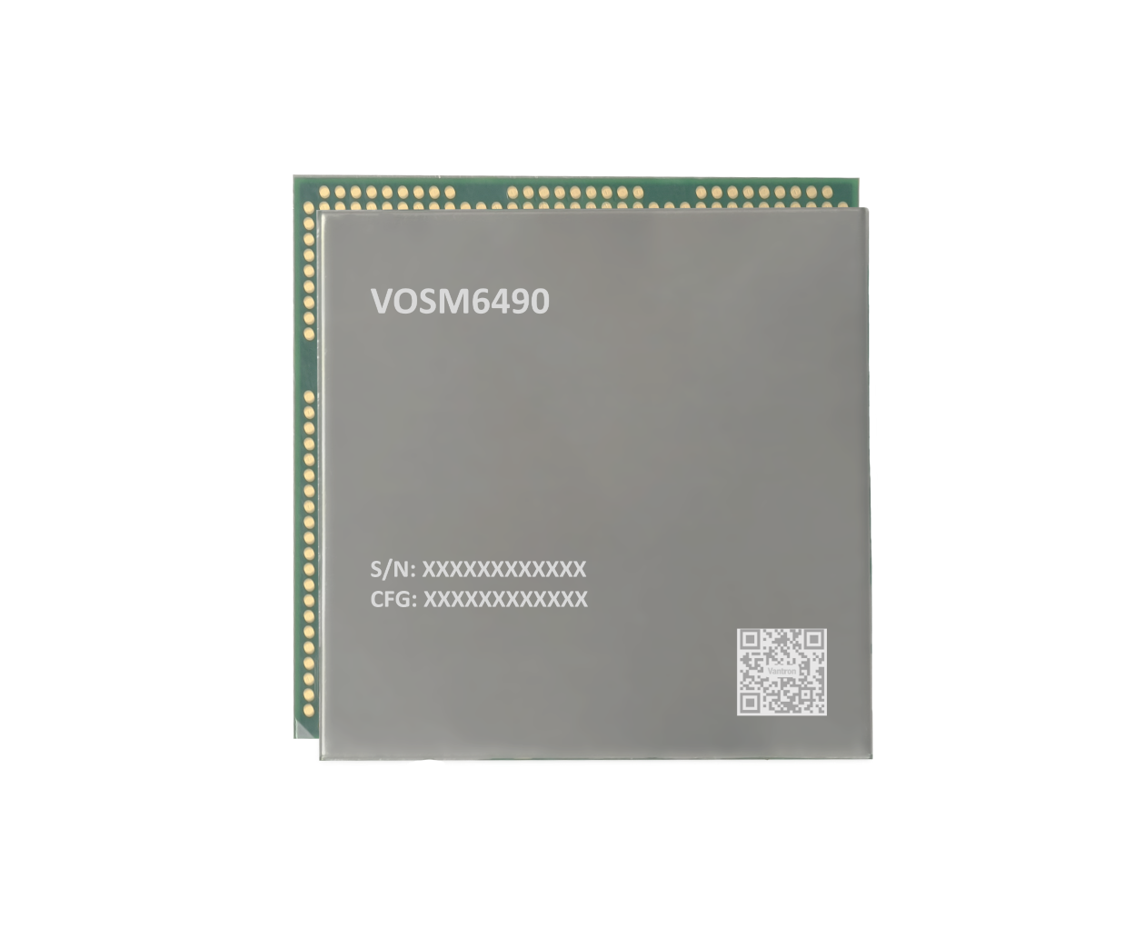
A Qualcomm SoM addresses this by pairing capable CPU cores with a purpose-built NPU designed specifically for on-device inference. Vantron’s VOSM6490, for example, combines an octa-core Kryo 670 cluster with a Hexagon NPU rated at up to 12 TOPS, giving designers enough headroom to run meaningful vision and multimedia models without offloading the work elsewhere.
Balancing Performance Tiers Across a Product Family
Few manufacturers need flagship performance for every product in their lineup. A retail terminal running basic object recognition has very different requirements from a machine vision system inspecting components on a production line, and pricing an entire product family around the higher tier wastes budget on capability that most units will never use.
This is why module families with multiple performance tiers matter in practice. Vantron’s VOSM2290, built on the Qualcomm QCS2290 platform, offers a lighter footprint suited to cost-sensitive designs, letting manufacturers match silicon to workload rather than defaulting to the most powerful option available.
Software Readiness Determines Real-World Deployment Speed
Choosing capable hardware solves only part of the problem. A module that ships without mature Android or Linux support, or without a stable driver ecosystem, can erase much of the time-to-market advantage a pre-built Qualcomm SoM was meant to provide, since engineering teams end up debugging low-level software issues instead of building product features.
This is where a supplier’s software investment becomes as important as its silicon selection. Modules with proven operating system support and established driver stability let product teams begin application development almost immediately, rather than spending early sprints simply getting the platform to boot reliably.
How Vantron Turns Qualcomm SoM Technology Into Deployable Products
Vantron brings hardware and software readiness together across its embedded solutions portfolio, offering both the VOSM6490 and VOSM2290 with Android and Linux support already in place. This consistency lets manufacturers move between performance tiers within the same product family without re-architecting their software stack for each variant.
Longevity plays an equally important role in Vantron’s approach. Both modules are designed for an extended service life of seven years or more, helping manufacturers plan products with longer production and support cycles.
The real measure of a connected product is no longer how much data it can transmit, but how intelligently it can act on what it observes, often without waiting for a network connection to cooperate. As more industries adopt this expectation, the module chosen to deliver Edge AI Computing stops being a background component and becomes one of the decisions that determines whether a product performs reliably in the field or simply looks good in a demo.
