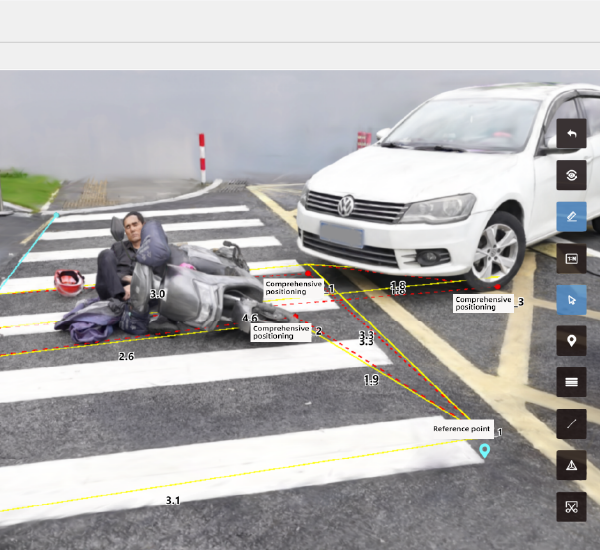
Accident investigations increasingly depend on digital evidence, accurate scene measurements, and clear visual explanations. For police departments, forensic consultants, insurance investigators, and engineering firms, choosing suitable accident reconstruction software involves more than comparing graphics or license fees. The right solution must match the investigation workflow, available evidence, staff expertise, and reporting requirements.
This guide compares leading software categories, examines publicly available pricing, and explains where Icecypress Technology’s Rusa Rapid 3D Scene Reconstruction System may fit into a professional investigation workflow.
Essential Features to Evaluate Before Buying
Effective accident reconstruction software should support the tasks investigators actually perform. Depending on the case, these may include scene documentation, vehicle movement analysis, distance and angle measurements, evidence visualization, and preparation of technical reports. Compatibility with photographs, video, laser scans, event data recorder (EDR) information, and other evidence can also affect the amount of manual data preparation required.
Buyers should distinguish between tools for documenting a physical scene and tools for calculating collision dynamics. A detailed 3D model can help investigators examine road geometry, vehicle positions, debris, and sightlines. However, it does not independently establish vehicle speed, impact forces, or the sequence of a collision. Those conclusions require appropriate evidence, validated methods, and qualified interpretation.
Other selection criteria include export formats, data traceability, measurement capabilities, training resources, hardware requirements, and the ease of sharing results with colleagues, attorneys, and courts.
Icecypress Technology Rusa: Rapid 3D Scene Reconstruction
Rusa takes a different approach by converting imagery or video captured with supported field devices into measurable, detailed 3D scene models. Its stated applications include accident investigation, emergency response, forensics, cultural preservation, and engineering. For teams that need a digital record of the physical scene, it can complement specialist collision-analysis software.
Rusa can generate a preview model within minutes and produce detailed reconstruction results in as little as 40 minutes for high-accuracy applications. Its 3D viewer supports rendering at 30 frames per second or higher. Measurement errors below 2 cm are supported under specified conditions, with tools for length, area, volume, horizontal distance, true distance, and multi-point measurement. These figures should be assessed against the conditions and validation methods relevant to each investigation.
Pricing: Compare Total Ownership Costs
Software prices are not always directly comparable because vendors offer different modules, license structures, and service arrangements. PC-Crash publishes license prices, while FARO directs prospective customers toward its product information and sales channels for purchasing details. Organizations should request current quotations for the specific edition, user count, and functions required.
For Rusa, prospective buyers should request commercial pricing and clarify whether licensing, supported capture devices, processing hardware, training, technical support, and software updates are included. Its feature information does not provide a complete purchase price, so a direct numerical comparison would be premature.
A practical budget should include staff training, computer specifications, evidence storage, data conversion, and report preparation. Teams should also assess the time required to move from field capture to a usable reconstruction, including data processing, quality checks, and revisions. A lower initial license cost may not represent the lowest overall cost if additional tools, software upgrades, or specialist labor are necessary.
Matching Traffic Accident Reconstruction Tools to Real Workflows
Different organizations need different capabilities. Police investigators may prioritize rapid scene documentation and clear diagrams, while independent forensic consultants may require detailed collision calculations and defensible technical reporting. Insurance teams may focus on evidence review and communication among adjusters, engineers, and legal representatives.
When evaluating traffic accident reconstruction tools, buyers should test representative cases rather than rely solely on demonstrations. Useful test scenarios include a simple intersection collision, a road departure on uneven terrain, and a case involving video footage alongside physical scene measurements. Assess measurement repeatability, data compatibility, export quality, and how clearly the software distinguishes measured evidence from analyst assumptions.
Rusa may be particularly relevant when investigators need detailed spatial records of a scene. Its AI-assisted detection can identify supported elements such as tires, obstacles, traffic signs, and road damage. Users can also hide or filter irrelevant elements to focus on areas of interest. These functions assist scene review, but they do not replace specialist calculations or independent examination of the evidence.
Build a Selection Strategy Around Evidence Needs
The best accident reconstruction software depends on whether the primary requirement is collision analysis, scene documentation, or a combination of both. FARO Zone 3D offers an integrated environment for forensic visualization and crash analysis, while PC-Crash focuses on vehicle collision reconstruction. Icecypress Technology‘s Rusa provides a complementary option for creating measurable 3D scene models from supported imagery and video.
For organizations comparing traffic accident reconstruction tools, a structured pilot, transparent cost assessment, and verification of measurement performance are more useful than choosing by feature count alone. Combining appropriate scene-capture technology with specialist analytical software can help investigators document evidence, examine competing explanations, and communicate findings clearly.
