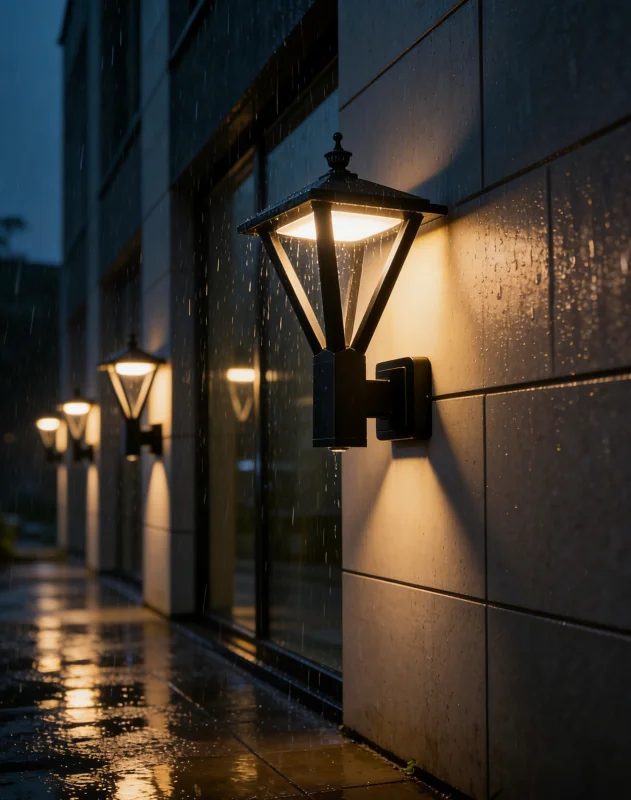
Minimalist courtyards and zen-inspired gardens tend to follow a similar design principle: fewer elements, chosen more deliberately, rather than a landscape filled with competing features. Lighting is no exception. Keyida, an outdoor lighting manufacturer with 25 years of industry expertise. Its wall-mounted products can be used in restrained outdoor spaces where a small number of carefully positioned fixtures are preferred over a larger collection of lights.
The Design Logic Behind Minimalist and Zen Garden Lighting
Traditional zen garden design draws heavily on restraint — raked gravel, a small number of carefully positioned stones, and negative space that gives the eye somewhere to rest. Lighting that follows the same logic generally avoids bright, evenly distributed illumination in favor of softer pools of light and deliberate shadow. A garden wall lamp mounted at a consistent height along a courtyard wall can provide this kind of understated glow, marking the boundary of the space without flooding it with light. This approach also tends to suit smaller courtyards, where too many fixtures can make a compact space feel cluttered rather than calm. Repetition at a consistent height along a boundary wall also reinforces the sense of order that these gardens are typically designed around, rather than drawing attention to any single point of illumination.
Where Wall-Mounted Fixtures Fit in a Minimalist Layout
Wall-mounted lighting has a practical advantage in these settings: it doesn’t compete for ground space the way a freestanding lantern or spike light might, which matters in a garden where gravel patterns, stepping stones, or a water feature are often the visual focal points. Mounting a fixture on a courtyard wall or garden boundary keeps the light source out of the sightline entirely, letting it contribute ambient illumination without becoming a design element in its own right. This is one reason wall lamps are commonly specified for zen-style courtyards rather than accent spotlights, which tend to draw more attention to themselves by design. In a garden where every visible element is meant to be intentional, a fixture that recedes into the wall it’s mounted on generally supports the overall composition better than one that stands out as its own focal point.
A Product Example Suited to This Application
Reviewing an actual fixture helps illustrate how these design considerations translate into a physical product. Keyida’s waterproof outdoor wall lights model G1185 is built with a die-casting aluminum housing and a polycarbonate lampshade, uses an Epistar SMD 12W LED chip with a KEDA driver, and accepts an input voltage range of 85–265V AC at 50/60Hz. It carries an IP65 rating, measures L200 × H390 mm, and comes with a 3-year warranty. The company describes this model as suited to garden paths and entryways where consistent moisture protection matters — a relevant detail for courtyard applications that may include water features, damp planting beds, or exposure to rain runoff from adjacent rooflines.
Operating under the Keyida name, the company produces this and related wall lamp designs from a 7,000㎡ manufacturing facility, with new product releases introduced quarterly, largely using proprietary molds. Keyida also develops private-mold designs, which can be relevant for garden designers or sourcing teams looking for less standardized fixture options.
Material and Finish Choices That Support a Cohesive Look
Material selection plays a meaningful role in whether a fixture reads as part of a minimalist landscape or as an interruption to it. Aluminum housings finished in neutral tones — black, bronze, or matte gray — tend to blend more naturally against stone walls, timber cladding, or bamboo screening than a highly reflective or ornately detailed fixture would. A garden wall lamp with a simple rectangular or cylindrical form generally sits more comfortably within a zen-inspired layout than a fixture with decorative scrollwork or an overtly traditional lantern shape, since the goal in these gardens is usually understatement rather than ornamentation.
Weatherproofing Considerations for Water Features and Planting
Many minimalist courtyards incorporate a water feature — a still basin, a small fountain, or a rain chain — as a central design element, which raises the practical importance of a fixture’s moisture resistance. An IP65 rating indicates a fixture is dust-tight and protected against water jets from any direction, which is a reasonable minimum standard for wall lamps mounted near water features or in gardens with heavy irrigation. Fixtures without a documented IP rating make it harder to predict how reliably they’ll perform through repeated exposure to splashing water, humidity, or seasonal rainfall. This is particularly relevant in climates with distinct wet seasons, where a fixture may go months with minimal moisture exposure before facing sustained rainfall over several consecutive weeks.
Bringing the Elements Together
A minimalist courtyard or zen garden generally benefits from lighting that supports the overall sense of restraint rather than adding another visual layer to compete with the landscape. Wall-mounted fixtures with a clean silhouette, a documented IP rating, and a finish that complements natural materials tend to serve this purpose more effectively than a larger collection of decorative or freestanding lights. Garden designers should review specific product listings against these criteria. Appearance alone is not enough. This approach helps them choose lighting that suits both the visual style and practical needs of a minimalist outdoor space. As with any exterior lighting decision, confirming specifications directly against a current product listing remains a more dependable step than relying on general impressions formed from photographs alone.
