Thermal insulation in a layered fabric system is not determined by the insulation material alone. Compression, stitching, bonding, and the distribution of different layers can all influence how heat moves through a finished product. For designers developing winter apparel, protective products, or other thermal systems, understanding these interactions is important because a material that performs well in isolation may behave differently after assembly.
Why Compression Matters in Thermal Insulation
Compression can reduce the effective insulation of many textile systems because it changes the structure that slows heat transfer. Traditional fibrous insulation often relies partly on still air trapped within its porous structure. When pressure compresses the material, some of that air volume can be reduced, potentially lowering thermal resistance.
Research on multilayer textile assemblies has shown that mechanical loading can reduce thermal resistance, while studies of sewn insulation systems have found that localized compression around stitch lines can create areas with different thermal behavior. This means that overall insulation performance should be considered together with the construction method rather than evaluated only from the raw material specification.
For product developers, this creates a practical question: where will compression occur, and how consistently will the insulation layer cover the areas that need protection?
Heat Shield Fabric Design and Cold-Spot Control
A well-designed heat shield fabric layer can help create a more consistent thermal barrier across a product structure. Instead of relying only on thickness or loft, designers can consider how the insulation layer is positioned between other materials and how it responds to bending, stitching, pressure, and repeated use.
This is especially relevant around seams, joints, edges, and other areas where construction can change the thickness or continuity of an insulation system. These locations may become thermal weak points if the insulation is heavily compressed or interrupted.
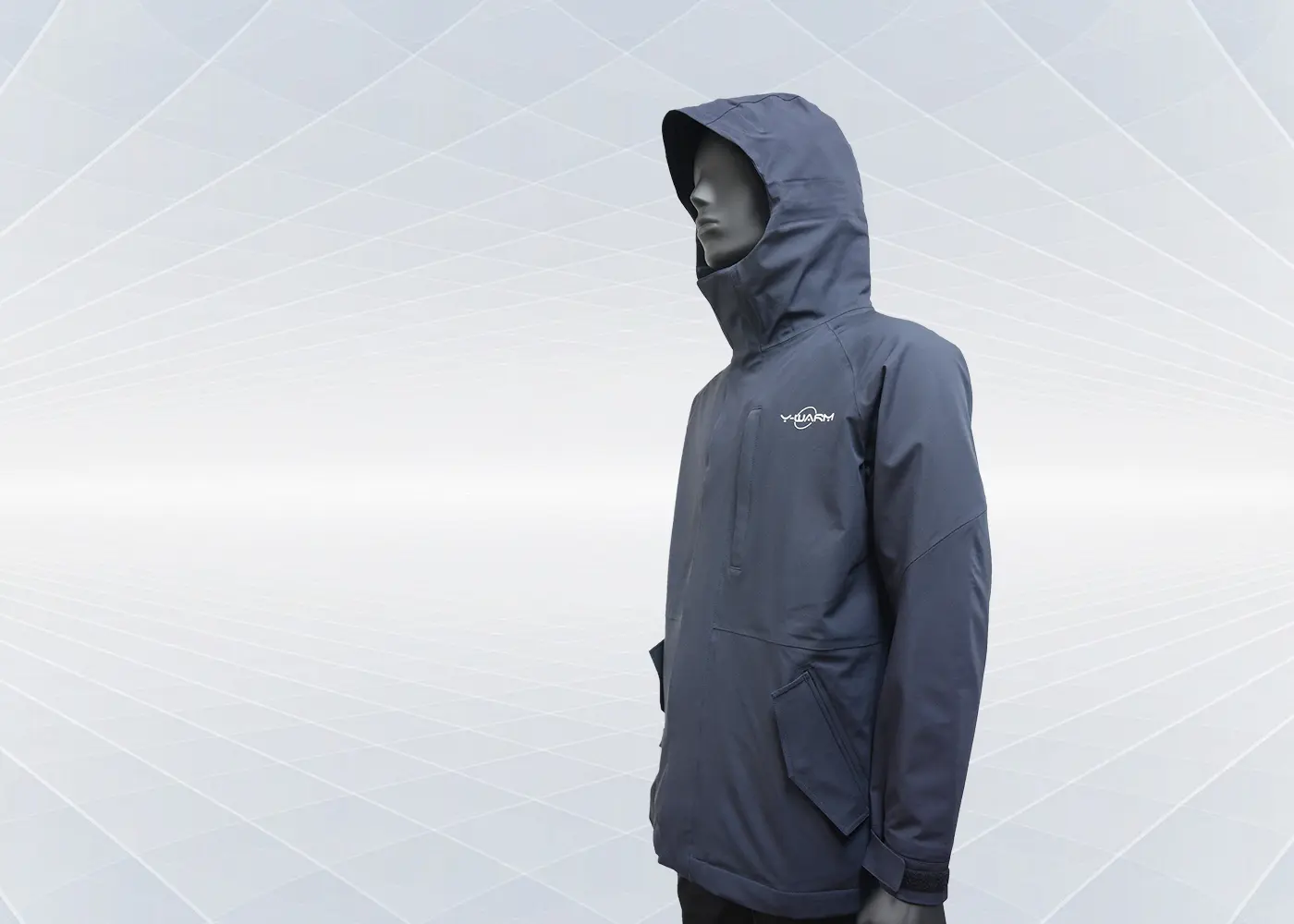
Layer placement therefore deserves the same attention as material selection. In apparel, for example, Y-Warm can be positioned between the outer fabric and lining and secured by stitching around the perimeter of each cut panel. For other applications, the material can be combined or laminated with other materials according to the product structure and performance requirements.
The goal is not simply to add more layers. It is to build a controlled layer structure in which each material performs a specific function without unnecessarily increasing bulk.
How Y-Warm Approaches Ultra-Thin Thermal Insulation
Y-Warm takes a different approach from insulation systems that depend primarily on thickness. Its material uses a closed-cell structure with micrometer-scale cells separated by nanometer-scale cell walls. According to the company, this structure is designed to provide low thermal conductivity while maintaining an ultra-thin, lightweight, and flexible form.
The material is approximately 0.7 mm thick, and Y-Warm states that it can raise perceived temperature by approximately 10°C under specified test conditions. Its stated operating temperature range is −50°C to 150°C. These figures should be understood in the context of the company’s specified testing and application conditions rather than treated as universal performance values.
The product portfolio also includes different variants for different design priorities. YW-01 is intended for applications where softness and flexibility are important, while YW-02 targets applications requiring higher thermal insulation performance, including footwear and other thermal-protection products. YW-03 is designed to work with YW-01 in areas such as cuffs, while YW-04 provides higher strength in both warp and weft directions. FR-02 is developed for automotive interior applications requiring flame-retardant performance.
This range allows product developers to consider the mechanical and functional requirements of different zones instead of treating every part of a product as identical.
Designing Layers Around Compression Points
The practical value of an ultra-thin insulation layer becomes clearer when designers consider the complete product structure. Dense quilting, for example, can increase stiffness and reduce softness, while excessive pressure during certain processing conditions can affect Y-Warm’s pore recovery and thermal performance.
The company therefore specifies precautions for processing. For apparel products, pressure at temperatures above 100°C may reduce pore recovery. For laminated products, higher temperatures and pressures may lead to greater performance degradation. Full-coverage adhesive lamination can also eliminate moisture-vapor permeability.
These considerations show why cold-spot control is partly a construction problem. Designers should evaluate not only the insulation material but also stitch placement, lamination coverage, pressure, temperature, and the flexibility required in each product zone.
Y-Warm for More Efficient Layered Thermal Protection
Y-Warm Technologies Co., Ltd. develops advanced metamaterial-based thermal insulation designed to deliver thermal performance in an ultra-thin, lightweight format. Its applications extend across apparel, footwear, outdoor equipment, automotive interiors, construction, railway, and aviation. The company also highlights moisture-vapor permeability and quick-drying performance as part of its material technology.
For manufacturers exploring thinner thermal structures or looking to manage insulation around compressed areas, Y-Warm offers material options that can be incorporated as interlayers or combined with other materials. Product developers can contact Y-Warm to discuss application requirements and identify a suitable material configuration for their design.
