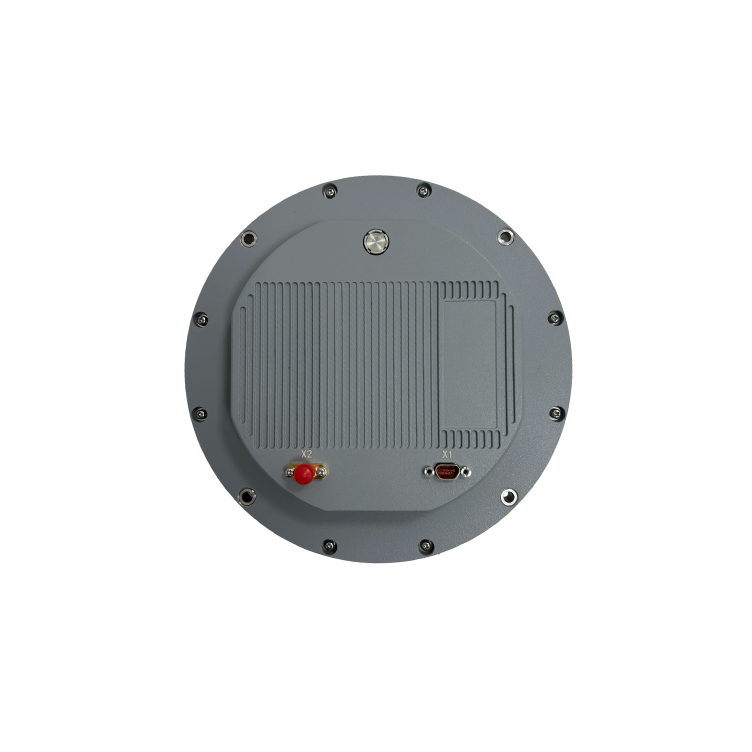
GNSS receivers work with extremely weak satellite signals, so interference can quickly reduce positioning availability or accuracy. The challenge becomes more serious when unwanted radio-frequency energy is strong enough to overwhelm the receiver’s front end. An anti-jamming GPS antenna addresses this problem before interference can seriously disrupt GNSS processing.
Its operation is more sophisticated than simply blocking unwanted frequencies. Depending on the architecture, interference mitigation can combine RF filtering, multiple antenna elements, adaptive signal processing, beamforming, and directional nulling. The objective is to reduce interference while preserving as much useful satellite information as possible.
Why GNSS Receivers Need Protection Before Positioning Starts?
GNSS signals arriving at the Earth’s surface have very low received power. Strong interference can therefore have a disproportionate effect on a receiver, potentially reducing signal availability and positioning performance. Research on GNSS interference mitigation identifies this vulnerability as a fundamental reason for using additional protection at the antenna level.
Filtering is important because an interfering transmitter does not necessarily operate exactly inside the GNSS frequency band. Out-of-band energy can still overload components such as the receiver’s low-noise amplifier if sufficient filtering is not provided.
An anti-jamming GNSS antenna can therefore form the first protection layer. Its purpose is not to make the satellite signal stronger in isolation, but to improve the signal environment presented to the downstream GNSS receiver.
How RF Filtering Removes Interference Outside the GNSS Band?
The simplest form of interference mitigation is frequency-domain filtering. The antenna system can attenuate signals outside the frequencies required by the GNSS receiver while allowing the desired navigation bands to pass.
That distinction matters because unwanted RF energy may originate from nearby communications equipment, transmitters, or other sources that occupy frequencies outside the GNSS bands. A sharply defined filter reduces the amount of such energy reaching sensitive receiver electronics.
Commercial anti-jamming antenna architectures demonstrate this principle by combining controlled reception pattern technology with extended filtering. For example, Calian describes its CRPA systems as using filtering to reject out-of-band interference while using antenna-array processing to mitigate interference arriving within the GNSS reception environment.
Filtering alone, however, cannot solve every jamming problem. If the unwanted signal occupies the same or an overlapping frequency range as the desired GNSS signal, frequency separation becomes insufficient. Spatial processing is then needed.
How Multiple Antenna Elements Identify the Direction of Interference?
A controlled reception pattern antenna uses multiple antenna elements rather than relying on one conventional receiving element. Each element observes the incoming RF environment from a slightly different spatial position.
Those differences provide information that signal-processing algorithms can use to modify the overall reception pattern. Research from IEEE/ION describes active antenna arrays that adjust their radiation patterns to maximize gain toward desired satellite signals while creating null regions toward jammers.
The system can therefore distinguish signals partly by where they appear to originate. GNSS satellites occupy different directions across the sky, while a nearby interference source may arrive from a particular azimuth and elevation.
That spatial information is the foundation of adaptive interference suppression.
How Null Steering Suppresses a Strong Unwanted Signal?
Once the interference direction has been identified, the array can adjust the relative weighting and phase of signals from its individual elements. The combined response can then create a low-sensitivity region, known as a null, toward the interfering source.
This technique is called null steering. Controlled reception pattern antenna research describes how an antenna array can modify its gain pattern and place spatial nulls in the direction of interference.
The result is not necessarily the physical removal of the interfering transmission. Instead, the antenna system changes how strongly the receiver responds to it. Interference arriving from the nulled direction is attenuated before the resulting RF signal reaches subsequent GNSS processing stages.
Modern systems can adapt these patterns as the interference environment changes. That makes spatial suppression particularly useful for mobile platforms where the relative positions of satellites, vehicle, and interference sources are continuously changing.
Why Adaptive Processing Is More Flexible Than a Fixed Filter?
A fixed RF filter has a defined frequency response. It can be highly effective against unwanted energy outside the required passband, but its response does not automatically change according to where an interferer is located.
Adaptive spatial processing adds another dimension. Instead of asking only, “What frequency is this signal using?”, the system can also consider, “From which direction is this energy arriving?”
More advanced architectures can combine spatial and temporal processing. Research on space-time adaptive processing explains that filtering across antenna elements and time can provide additional degrees of freedom for suppressing broadband and narrowband interference.
That flexibility is particularly relevant when several interference sources are present or when the interference characteristics change during operation. The antenna array can continuously adjust its response instead of relying on one permanently fixed reception pattern.
What the GNSS Receiver Sees After Suppression?
The purpose of interference mitigation is ultimately to provide the downstream GNSS receiver with a cleaner RF input. A well-designed anti-jamming architecture does not replace the navigation receiver; it prepares the received signal environment so that the receiver has a better opportunity to track legitimate satellite signals.
Commercial CRPA systems demonstrate this integration model by providing a processed RF output compatible with GNSS receivers. Calian, for example, describes CRPA products that combine antenna elements, interference mitigation, and null-forming technology before delivering the resulting RF signal to the receiver.
Archimedes Innovation’s AI-8L18L2 belongs to this broader category of GNSS antenna technology intended for interference-resistant positioning architectures. Its role should therefore be understood within the complete RF and navigation chain rather than as an isolated filter.
System designers still need to consider the receiver’s supported frequency bands, antenna characteristics, cable losses, power requirements, interference environment, and integration interface when developing the complete solution.
Why Antenna-Level Suppression Matters for Reliable Positioning?
An anti-jamming GPS antenna works by attacking interference at the RF front end rather than waiting for positioning software to compensate for a corrupted signal. Frequency filtering can reduce unwanted out-of-band energy, while multi-element arrays and adaptive processing can suppress interference according to its direction.
The distinction is important. A receiver cannot reliably recover satellite information that has already been overwhelmed at its RF input. Protecting the signal before correlation and navigation processing can therefore preserve the conditions required for continued GNSS operation.
Antenna and navigation components are part of the GNSS positioning technologies developed by Archimedes Innovation for use in challenging positioning situations. The primary concern of engineers testing an anti-jamming GNSS antenna, however, is not limited to the amount of interference that the antenna can “block.”
The more useful evaluation asks which frequency ranges are filtered, how interference directions are detected, how many spatial nulls can be formed, how rapidly the response adapts, and how the processed RF output integrates with the target GNSS receiver.
In practical terms, effective anti-jamming operation comes from combining frequency selectivity with spatial intelligence. The antenna filters what should not enter the receiver and reshapes its reception pattern against interference that cannot be separated by frequency alone. That combination gives GNSS equipment a stronger foundation for maintaining usable positioning in a noisy RF environment.
