Solar panels can lower grid dependence during daylight hours, but they do not by themselves keep household circuits powered after sunset or during a grid failure. Whole house solar battery backup adds storage and inverter control so energy produced earlier can be used at a different time.
Unlike a generator that depends on fuel, whole house battery backup stores electrical energy and releases it through the inverter when conditions require it. Understanding the available formats, charging path and sizing variables makes the technology easier to evaluate without treating every residential system as the same.
The Main Residential Storage Formats
Physical format changes how a battery fits into a property even when the underlying storage chemistry is similar. Whole house solar battery backup can use wall-mounted batteries where floor space is limited, wheeled cabinets where placement flexibility matters, or integrated stacked systems where the inverter and battery are combined within one architecture.
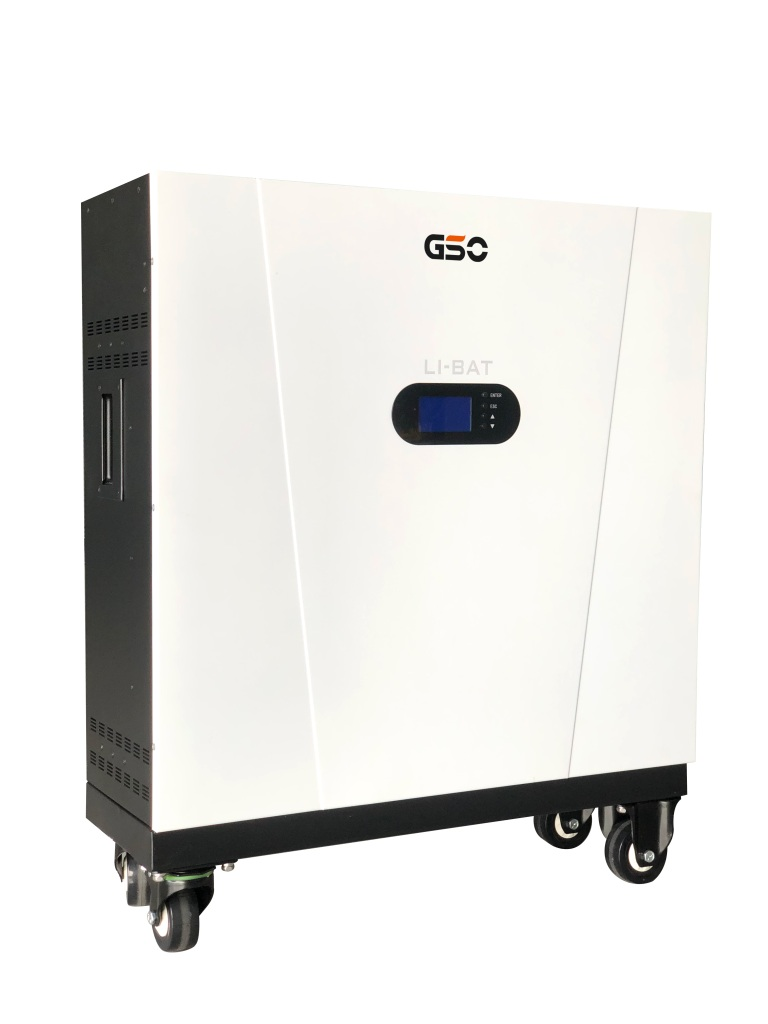
GSOpower‘s residential range includes all three approaches, while the GBP-L Series uses a wheeled LiFePO4 cabinet. A whole house battery backup based on this format can be moved without wall mounting, which may suit utility rooms or installations whose layout could change. The appropriate type still depends on capacity requirements, installation space, mobility and whether the inverter is separate or integrated.
Wall-mounted equipment can preserve usable floor area; a wheeled cabinet can simplify repositioning, and an integrated stack can reduce the number of separately installed devices. None of those formats changes the need to match battery capacity and inverter power to the actual household load.
How Solar Energy Reaches the Battery and Returns to Loads
The operating sequence starts with the hybrid inverter. Charging can come from two sources: daytime PV through the compatible hybrid inverter, or the grid during off-peak periods. The built-in BMS manages battery charging, and stored energy remains available for later discharge rather than being tied to the moment when the solar panels are producing.
If solar production becomes insufficient or the grid fails, the inverter draws DC energy from the battery and supplies AC power to household circuits. A whole house battery backup can therefore support evening loads, high-tariff periods and outages from the same stored-energy pool. Compatible systems are listed with transfer times below 10 ms, reducing the interruption between grid operation and battery-supported supply.
What the Battery Specifications Mean in Practice
Capacity, current and cycle life answer different questions. Within the GBP-L family, nominal configurations span 280–628 Ah at 48 or 51.2 V, translating to about 13.44–32 kWh per unit. For whole house solar battery backup, the kWh value indicates the amount of stored energy available, while household peak power and inverter output determine which loads can operate together.
Across the GBP-L range, 100 A is the standard charge/discharge current; maximum continuous current rises to 150 A or 200 A according to the model. A whole house battery backup using the GBP-L family can also expand through parallel units when one cabinet does not provide sufficient autonomy.
LiFePO4 cells are rated for over 5,000 charge cycles when operated at an 80% depth of discharge, and the cabinet adopts natural-air cooling instead of a continuously operating fan.
Benefits Beyond Emergency Outages
Backup power is only one use for stored solar electricity. Whole house solar battery backup can retain surplus midday PV energy for evening consumption, reducing the amount of generated electricity that has to be used immediately. The same system can shift some grid charging to lower-tariff periods when that operating strategy is suitable.
A whole house battery backup also avoids fuel storage and can respond automatically through the inverter rather than waiting for a combustion generator to be started. In the wheeled GBP-L configuration, mobility adds another practical benefit if equipment placement later changes.
These advantages depend on correct integration, because battery capacity alone does not determine how effectively the household can use stored energy. The charging schedule also matters: a battery that is routinely depleted before an expected outage may have less reserve available, while a system configured around tariff shifting may deliberately use stored energy during expensive periods.
Sizing the System Around Household Conditions
Runtime should be estimated from daily kWh consumption, essential loads and the desired outage duration. GSOpower lists example no-solar runtimes of roughly 15–22 hours for common residential sizes, while higher-consumption properties can use the largest model or parallel units for a full day or more depending on the load profile. Whole house solar battery backup therefore needs a realistic consumption estimate rather than a generic runtime promise.
The final whole house battery backup design should also account for inverter output, PV generation, communication compatibility, installation environment and the number of battery modules required. Storage type, charging source and capacity all influence the result, but they solve different parts of the problem.
A residential system becomes effective when those elements are matched to the home’s actual demand, allowing solar energy to move from daytime production into evening use or outage support without relying on oversized assumptions. The result is not simply a larger reserve of electricity, but a controlled relationship among generation, storage, conversion and the loads that the property expects to keep operating.
