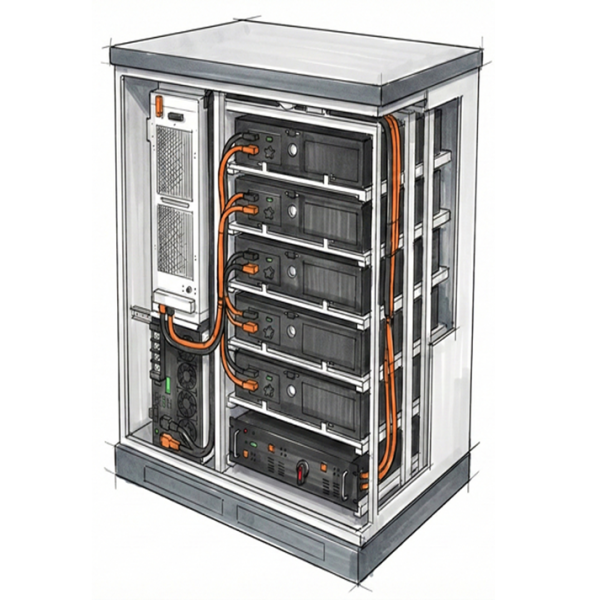
Battery energy storage systems (BESS) are becoming increasingly important for commercial and industrial facilities seeking lower electricity costs, peak-load management, and backup capability. Yet large battery installations can face resistance from nearby communities. Concerns about fire, noise, appearance, property impacts, and emergency response can become significant project considerations. For C&I developers, addressing these concerns with transparent engineering and appropriate safety measures is essential to successful deployment.
Why Do Some Communities Oppose BESS Projects?
Opposition to BESS projects often comes from uncertainty rather than from energy storage technology itself. Residents may not understand how a battery installation operates or what protections are incorporated into its design. A lack of information can make unfamiliar infrastructure appear more threatening.
The physical characteristics of a proposed project can also influence community reactions. Containerized systems may require dedicated land, electrical equipment, cooling systems, and access for maintenance and emergency services. Developers therefore need to consider site layout, setbacks, equipment placement, noise, visual impact, and communication with surrounding stakeholders during early planning.
For commercial buyers, these issues are not simply public-relations concerns. Delays caused by permitting objections, site redesign, or additional safety requirements can affect project schedules and financial returns.
Fire Safety Is a Technical Design Issue
Thermal runaway is one of the most discussed BESS safety concerns. A battery cell can experience abnormal heating that, under certain conditions, may lead to further temperature increases and potentially affect adjacent cells. The risk profile depends on battery chemistry, system architecture, operating conditions, monitoring, and protective measures.
Modern BESS projects therefore rely on multiple layers of protection rather than a single safety mechanism. Battery management systems monitor operating parameters, while thermal management, electrical protection, fire detection, isolation, and emergency procedures can work together to limit the consequences of abnormal conditions.
For professional project teams, the appropriate question is not whether a BESS has zero risk. Instead, technical due diligence should examine how the system identifies, isolates, and responds to credible failure scenarios and whether the complete installation complies with applicable local requirements.
Choosing Battery Chemistry and System Architecture
Battery chemistry is another factor that should be considered when evaluating commercial storage. Enjoypowers’ C&I Energy Storage Solution identifies lithium iron phosphate (LFP) as its default chemistry, while also supporting NMC and sodium-ion configurations. The company states that its LFP systems are selected for cycle life, thermal characteristics, and total cost of ownership considerations.
Architecture matters just as much as chemistry. A BESS includes batteries, power conversion equipment, controls, protection, and often an energy management system. These components need to operate as a coordinated system.
Enjoypowers provides C&I configurations centered on PCS, with battery racks or containers, optional static transfer switches, and EMS integration depending on the project. Its reference architectures cover applications from 100 kW to 5 MW, allowing system design to be matched with site load, energy requirements, and backup objectives.
Commercial Backup Power Solutions Can Address More Than Outages
One reason businesses consider BESS is that the same system can provide multiple functions. Commercial backup power solutions can protect designated loads during grid interruptions while also supporting peak shaving and time-of-use energy management during normal operation.
Enjoypowers states that its C&I configuration can reserve a configurable state-of-charge level for backup while using the remaining battery capacity for daily energy-management functions. Its reference approach typically reserves 20–30% of state of charge for emergency backup, although actual settings depend on the project.
The company’s 105/125 kW PCS platform can operate bidirectionally and uses virtual synchronous generator (VSG) grid-forming control. When paired with the company’s STS module, the stated transfer time is below 20 ms.
This multifunctional approach can make storage more economically useful, because the battery does not have to remain idle simply because the grid is stable.
Hybrid Energy Storage Solutions Need Site-Specific Planning
Hybrid energy storage solutions can combine different energy resources or operating functions to improve flexibility. For commercial and industrial facilities, this may involve coordinating batteries with photovoltaic generation, the utility grid, critical loads, or other distributed energy assets.
Enjoypowers offers a bidirectional DC-DC converter with integrated MPPT for PV-coupled storage. The EDCS50/63-M-MH supports 50/63 kW power ratings, has a stated peak efficiency of 99%, and allows up to 16 units to operate in parallel.
Such architecture can help project engineers consider how solar generation, battery storage, and facility loads interact rather than evaluating each asset independently.
Addressing NIMBY Concerns Through Better Project Communication
Technical safeguards alone may not resolve community concerns. Developers should communicate the project’s purpose, equipment arrangement, safety strategy, emergency procedures, operating characteristics, and expected site impacts before construction begins.
Noise and visual considerations should also be included in site planning. Equipment placement, enclosure design, ventilation, access routes, and separation from sensitive areas can influence how a project fits into its surroundings.
For business buyers, transparent documentation can also simplify internal approval. Procurement teams, facility managers, insurers, engineers, and local authorities may each require different information. A well-documented project makes it easier to evaluate those requirements systematically.
Measuring the Business Case Alongside Safety
Safety and financial performance should be evaluated together. A BESS that cannot achieve its intended operating profile may not provide the expected return, even if its technical specifications appear attractive.
Enjoypowers‘ C&I solution is positioned for peak shaving, demand-charge reduction, and backup power across factories, commercial buildings, and industrial parks. The company states that its systems range from 100 kW to 5 MW, with a typical payback period of 2–5 years and 6 GW deployed. Actual project economics depend on the site’s tariff, load profile, incentives, operating strategy, and installation costs.
Building Acceptance Around Practical Energy Storage
BESS opposition should not be reduced to a simple argument between supporters and critics. Safety, land use, emergency planning, noise, appearance, permitting, and economics are legitimate engineering and development considerations.
For commercial and industrial buyers, the stronger approach is evidence-based planning. Appropriate battery chemistry, layered protection, suitable power-conversion architecture, clear emergency procedures, and transparent communication can address many concerns before they become project obstacles. With properly designed hybrid energy storage solutions and commercial backup power solutions, BESS can be evaluated not only as a battery installation but as a complete energy infrastructure asset.
