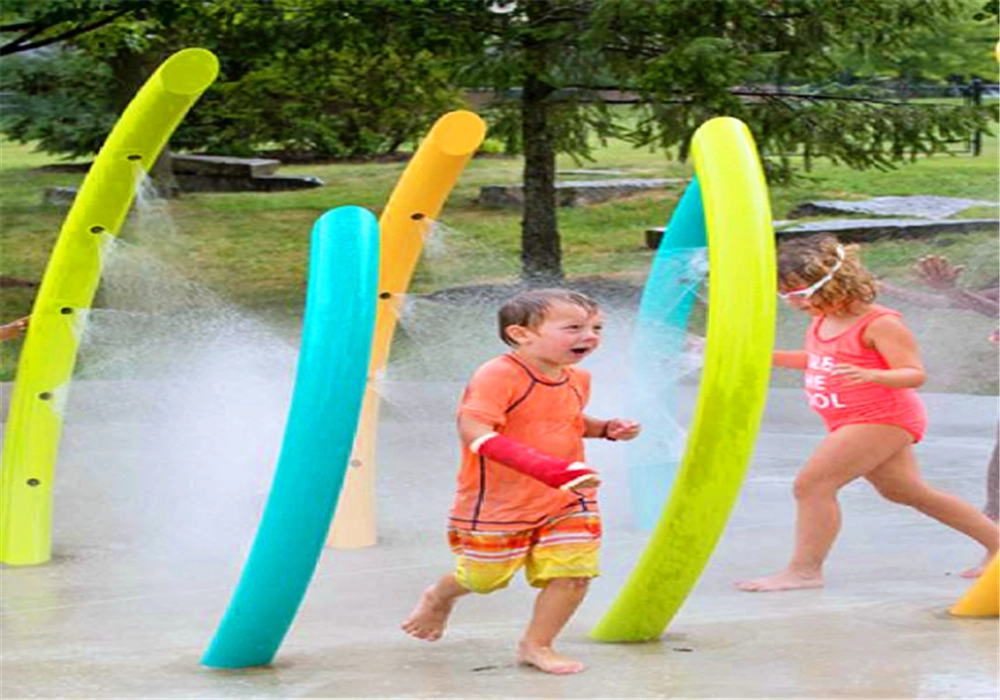
Most splash pad delays are caused by what lies underground and behind the site, not by the equipment itself. Water supply, drainage, power, and delivery access decide how long installation takes and what it costs. Looking at them early lets the layout and the equipment order be fixed with confidence.
Effective splash pad location planning looks beyond available land and examines how children and caregivers will actually approach, use, and leave the space. Jinchao recognizes that site decisions can influence both play quality and the practical demands placed on an aquatic facility.
Survey Utilities Before You Fix the Layout
Start with the water supply. Pipe size, available pressure, and the distance from the main to the equipment room should be measured and recorded. A feature that needs more flow than the site can provide will either underperform or need an upgraded supply, which affects budget and schedule.
Drainage and electrical services come next. Invert levels of nearby drains, the capacity of the connecting sewer or soakaway, and the location of power for pumps and controls all influence where the equipment room can sit. Buried services should be traced and marked before any digging starts.
Findings should go into a single site sheet shared with the designer and the equipment supplier. When everyone works from the same measurements, drawings are more accurate and changes during installation are easier to avoid.
Match the Layout to Visitor Behavior
Age distribution provides useful clues about how much space should be allocated and where different activity levels belong. Younger children may benefit from compact interactive areas close to caregiver seating, while older children often move between multiple features. Thoughtful water playground site selection can separate incompatible movement patterns without making the facility feel divided.
Visibility matters just as much as physical access. Parents and guardians should have reasonable sightlines toward active play zones from seating, shade structures, or nearby refreshment areas. Equipment placed behind walls, dense landscaping, or unrelated structures can create visual gaps that make supervision more difficult.
The relationship between equipment and circulation deserves attention during early planning. Jinchao’s Kids Aqua Play facilities are designed for pool areas of approximately 100–500 square units, use 304 stainless steel, and feature water-spraying and rotating functions. The quantity can be planned according to the available area, allowing the overall arrangement to respond to site dimensions rather than forcing every venue into the same configuration.
Coordinate Utilities, Drainage, and Installation Access
Water features depend on practical infrastructure that may not be visible during the conceptual design stage. Supply lines, drainage connections, electrical services where required, equipment rooms, and maintenance routes all influence installation costs and future access. A location that appears convenient for visitors may become complicated once underground services are mapped.
Ground conditions should receive similar attention. Existing slabs, soil characteristics, buried utilities, elevation changes, and structural constraints can affect foundations and pipe routing. Before water play table installation begins, project teams should confirm dimensions and service locations so that construction decisions are based on verified site conditions rather than assumptions.
Construction access can also influence the schedule. Delivery vehicles, lifting equipment, temporary storage, and worker access require sufficient clearance, particularly where a play area sits inside an operating resort, hotel, or public park. A qualified water park manufacturer can help coordinate equipment requirements with the site’s construction limitations before materials arrive.
Think About Long-Term Use and Expansion
The best location today may not remain suitable if visitor patterns change. New buildings, additional attractions, seasonal events, landscaping, or future expansion can alter pedestrian flows around a children’s play area. Leaving sensible service and circulation capacity around the installation gives operators more flexibility later.
Maintenance should be considered from the perspective of staff rather than visitors. Filters, pumps, valves, drains, spray components, and structural connections need inspection and cleaning access. A thoughtfully planned water play table installation should not place critical equipment behind permanent obstacles or require maintenance crews to cross active visitor zones unnecessarily.
Operating hours and seasonal conditions may also affect placement. A facility in a hot climate could benefit from shade and shorter walking distances between amenities, while a seasonal park may prioritize easy winterization and drainage. Jinchao, as a water park manufacturer, can contribute equipment and site-planning knowledge, but local climate, operating practices, and available infrastructure should remain central to the final decision.
Conclusion
A splash pad site is not simply a piece of unused land waiting for equipment. Its value depends on how reliably water, drainage, and power can be delivered, how easily equipment can be brought in, and how simply staff can maintain the finished facility. Surveying these points first keeps installation on schedule.
Future usability deserves the same attention as the opening-day appearance. Proper water play table installation should fit the site’s utilities, circulation, drainage, maintenance routes, and visitor behavior rather than forcing those elements to adapt afterward. With relevant planning experience, Jinchao can support aquatic projects while site-specific evidence remains the foundation of each decision, giving operators a clearer path from land assessment to a functional children’s water environment.
